


WARNING: This article contains major spoilers for the entire Mass Effect series.
Dissatisfaction
At this stage, almost anyone interested in the Mass Effect series has finished 3 and experienced the classic symptoms of a new medical condition, the Mass Effect 3 Ending Syndrome. You know what I’m talking about: As you play, the cacophony of Internet whiners seems so silly, so overblown… you think to yourself – how bad could it be? It’s just the Internet being the Internet – no game as good as this, in a series as superlative as this, from a developer as accomplished as this, can possibly end as poorly as they say. Then you play through the ending. As it is happening, it seems like some kind of surreal dream. Who is this holo-kid? I’m not sure I understand his explanation. Let me ask for a clarif… wait… that’s it? The Geth will die – I have to pick a color? Isn’t that going to strand everyo… well… OK… let’s see what happens… man… this music… it’s amazing, but I don’t understand what I’m seeing… isn’t this… wait… what’s Liara doing there? Why is Joker’s hat glowing? What?! Well, that was strange. Suddenly the credits roll; the little epilogue is followed by an astoundingly crass (given what has just transpired) dialog box reminder to get some DLC; and it’s all over.
So at first, there’s merely confusion and a faint sense of dissatisfaction. That is only the first stage. At this point, it’s possible to dismiss it as just another OK-ish, not-good conclusion to a great franchise. Those are common – right? Star Wars, Battlestar Galactica, LOST, Halo… the list goes on. I know that’s how I felt at first, a kind of unhappy feeling of, “the journey was great, but I don’t know about the destination.†Yet then one starts to think about it more – the classic Hitchcockian Refrigerator Moment occurs. With just a few minutes of reflection, especially having watched the other two endings, this vague sense of dissatisfaction quickly hardens into a brutally long list of questions, inconsistencies, and eventually grievances. Suddenly all the complainers don’t seem so silly anymore (excluding those filing FTC complaints and other such nonsense, of course). Hopping onto a message board to discuss it typically yields a disturbing sense of camaraderie with those already there, where message board threads become almost like support groups for those who have been afflicted by The Ending. If you’re lucky, you might get over it and move on. If you’re unlucky, the dreaded Indoctrination Theory – possibly the first case ever of people preferring “it was all a dream†to the actual events shown in the piece – might become your coping mechanism.
All in all, while it’s quite possible to be OK with the ending – or even (I shudder even as I type this) like it, as our own Chris Park did in his review – generally speaking, on average the more of a Mass Effect nerd one is, the more they hate the way the series concludes. This has made the Internet explode in a fiery battle. On one side are the angry fans and a few commentators (such as yours truly), lamenting the finale or even at times demanding a changed or extended ending; on the other side are the majority of the press, calling the fans “entitled†and dubbing the possibility (and now a certainty) of a changed or extended ending as a poor “precedent†and an affront to “artistic integrity.â€
BioWare, and EA, are of course stuck somewhere in the middle. Are they doing the right thing in response? Before I answer, allow me to discuss in a little more detail what the actual problem is.

The problem
“The game’s controversial last few minutes really have something for almost everyone to hate.”
Why exactly are the endings so controversial? All in all, there’s no single over-arching problem (like a specific plot hole) that is the cause of all complaints. The game’s controversial last few minutes really have something for almost everyone to hate.
First come the simple, logical plot holes. For example, in the past we have learned that destroying a mass relay makes it go supernova, thus destroying the nearby solar system – yet in this one it doesn’t seem to (at least I hope not). Another head-scratcher: In the optimal (?) ending (only achievable by playing certain iOS games or playing online, and by electing to destroy the Reapers), Shepard survives in a two-second epilogue. If the Citadel exploded, which is clearly shown, how could she survive? Why is EDI alive if she is a synthetic being? How does Shepard’s squad mate end up on the Normandy and then crash-land on the planet? The list goes on.
With enough imagination those plot holes can be explained away (BioWare writers have indeed done so in recent days around PAX, and some will be filled in by the coming Extended Cut DLC). Even so, the next problem is closure. It isn’t about things that don’t make sense; it’s about not knowing what actually happened. It’s not about wanting a happy ending; it’s about understanding the ending we got. I want to at least know what I just did, even if it’s not all sunshine and roses. The big one: if the mass relays are all destroyed, then aren’t 100% of the galaxy’s fleets now stuck in our solar system or at least our cluster, with no reasonable way to get back to their home worlds? Would they starve? Would another huge war now begin over the scarce remaining resources in our system? Would Tali then never be able to build that house on Rannoch? Will the Krogan explode into another horrible war without Wrex’s guidance? If, on the other hand, relay-less FTL travel is practical, then why the strange epilogue with the old man and the kid, which heavily implies that interstellar travel is no longer possible even a long time later?
In other words, the game tells the player (very briefly) what is about to happen, but it doesn’t show you what happens. A golden rule in a visual medium is to show… not tell.
This ties into the next, and perhaps biggest, problem with the endings: Even ignoring the appalling lack of closure or logic in the ending cinematic, the Catalyst’s ultimate explanation of the game’s greatest mystery, the Reapers’ rationale – and the choices provided to resolve it – are stunningly inadequate. The idea that synthetic life is somehow not particularly different from nor hostile to organic life is repeatedly hammered into our brains throughout the series, be it through the characters of EDI and Legion or through plot lines such as the Quarian-Geth conflict. The Geth are nothing more than an alien race systematically oppressed by their creators the Quarians; they just happen to be synthetic and created by the Quarians themselves. EDI is basically a sexier version of Commander Data. So when the Catalyst informs us, in a couple of sentences, that the Reapers’ heretofore-mysterious mission (as synthetics themselves, no less) is actually to kill off most sentient organics to prevent them from making synthetics that would inevitably kill off those organics, it’s hard to buy. It’s hard to buy not just because it’s logically tough (though not impossible) to accept, but also because it seems to be a complete 180 over what we’ve personally experienced in the games to that point. To be fair, an argument can be made that the Reapers are preventing a technological singularity, which is quite different from the Geth or EDI situation, but while on paper that can work, it just doesn’t feel at all thematically consistent with the series.
Has the game given any real hint of the horrors of a technological singularity? No. Does it do so during this explanation? Not really. It’s just a couple of sentences. Giving the player no time to process this frankly stunningly-out-of-left-field explanation of the Reapers (not even a dialog wheel sequence for clarification!), it then presents the player with a list of inadequate choices. The one most difficult to attain, the “green†choice, involves merging organics and synthetics into one, thus preventing the organic-synthetic cycle. To many this is a rather abhorrent idea; almost universally it is also seen as magical and implausible. What possible force in the universe other than a god could do something like that with a green beam? More than that, it is yet another example of the game telling, not showing. All we see is that Joker has oddly glowing eyes and gives EDI a hug. This is going to prevent a technological singularity from destroying organics? Really?
It is unconvincing, to say the least. It is also an amazing change of tone from BioWare’s normal mode of storytelling. It is like watching a Star Wars film suddenly turn into 2001 in the last five minutes. There’s nothing wrong with 2001 itself, but it doesn’t belong in a movie featuring wookiees and speeder chases. Similarly, Mass Effect is a war story and always has been. It is about a single figure, Commander Shepard, overcoming every bit of galactic adversity to uncover a number of objective truths and defeat a number of specific and powerful adversaries. To have a journey like that end with a limply surreal choice – that isn’t even a choice given the almost exact similarity of each ending to the others – with no ability to protest, or at least understand, this choice – feels like a slap in the face. Having it all end with some kind of attempt at an arty philosophical conclusion in the final cinematic, a-la Deus Ex, is another. In the end that is what it all comes down to… it is an example of (perhaps unintentional) lack of respect for the player on the part of the writers.
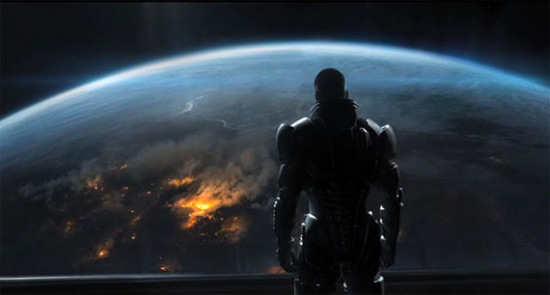
The fate of Earth and the galaxy hangs in the balance...
The solution
All of this has put BioWare into an odd position. Doing nothing is certainly the developer’s right; any suggestion that the ending is some kind of affront deserving of an FTC complaint or out-of-regular-policy retailer refunds is patently ridiculous. (After all, many $60 games are simply bad without causing such a reaction… being unsatisfied is always a risk when buying a product.) Yet, as EA and BioWare have clearly concluded, it’s not a great idea to do nothing here. The outcry has been too loud, and even calling the ending’s critics “entitled†or a “vocal minority†is a recipe for failure. After all criticism isn’t “entitlement,†and everybody knows that most people really don’t like the ending – just like everybody knows that most people don’t like The Phantom Menace despite its huge box office returns.
“Art works are changed based on feedback all the time.”
So doing nothing is probably a non-starter. Many fans (though probably a minority, to be fair) do want the ending simply changed to something else, preferably getting rid of the Catalyst Kid entirely. The main argument against this, frequently put forth by various gaming media outlets, is that it is a horrible precedent and an affront to artistic integrity. Well, as others have noted, it’s not any precedent; endings have been changed before, such as in the case of Fallout 3. As for the artistic integrity argument, that is plainly nonsensical. Art works are changed based on feedback all the time. Ever heard of pre-release screenings? Classic writers, such as Dickens, have literally changed endings after initial publication. Do they lack artistic integrity? I don’t think so. As long as the artist feels comfortable changing their work, it is their right, and there is nothing wrong with it in itself. Sometimes these changes are laughable (see Lucas, George), but they are only laughable on the merits of the changes themselves – not because of having been made at all.
The only real argument against simply replacing the ending with something else is the impracticality of it in this case. That ending, once seen, cannot be unseen. Coming up with an entirely different plot device to replace the Catalyst Kid is akin to BioWare announcing to the world, “You are right; we are terrible writers who don’t know our own universe; please tell us how our plot should go, and we’ll put it in for you.†Asking for something like that is, in my eyes, rather petulant and unreasonable for obvious reasons. It would basically strip BioWare of all dignity – and, yes, cynical Internet gamers, BioWare do still have dignity.
So what does that leave for BioWare? The answer: do the best with what you have. They’ve written themselves into some serious plot holes, and the ultimate explanation for everything remains weak and unfixable without a total rewrite, but they certainly can extend what they have to provide all-important closure. Explain just what happens after the red-green-blue beam of joy spreads through the galaxy. Show what happens to Shepard’s squad (and maybe even Shepard) as the relay network disintegrates. Give some context to the state of the galaxy after these events. These are all things that can be accomplished. It won’t make everyone happy, of course, but it can still help this thing… and maybe save the experience for those that haven’t yet played the game.
To BioWare’s credit, that is exactly what they plan on doing (and for free, which, while arguably the only option available to them, is still commendable). The coming Extended Cut DLC can be implemented many different ways, but so far it has been described as pretty much exactly what I just proposed. They haven’t petulantly pointed to the game’s high Metacritic score, appealed to the “gamers are just entitled†argument, or simply ignored the problem. Of course after the negative reaction to Dragon Age II they probably feel that acting defiantly is not in their best interest, but regardless of the motivation what matters is action.
BioWare – having made a big mistake – are doing their best to rectify it. Cynics be damned, I look forward to how successful they are at doing so.





8 Responses to BioWare made a big mistake, but they are doing the right thing now